CBM
Futurama
IBM PC-AT
Contact
Games
Glossary
Hall of fame
Hall of shame
Miscellaneous
MASK Characters
OJ acquitted
Apples oranges
Dimensional units
English IQ
Faction test result
Hierarchy of competence
Impossible compression
Megatron vs kitten
Prime number counting
Quantum particles
Privacy policy
Programming
Twisty puzzles
In the Standard Model, elementary (and composite) quantum particles can be organized in many ways. Below is a graph that I created (grouping particles by 'class') which I hope will be educational to you (it was just a fun graph for me).
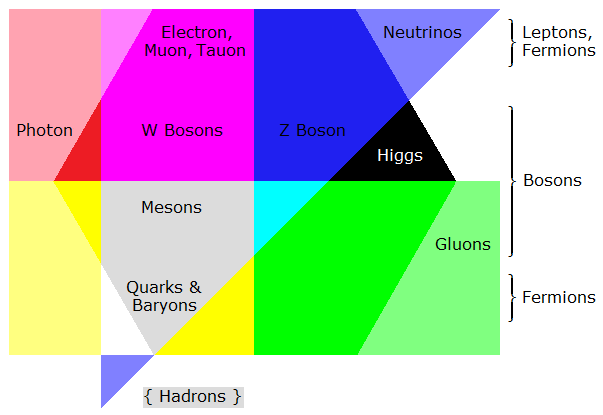
The graph shows the intersection of the three most powerful forces and the Higgs field. Each is rendered as a colored geometric shape:
- The electromagnetic force [transmitted by the Photon] is a light-red rectangle on the left half of the graph. It contains affected quantum particles: Electron/Muon/Tuaon, W Bosons, Mesons, and Quarks/Baryons.
- The strong nuclear force [transmitted by Gluons] is a light-green rectangle on the bottom half of the graph. It contains affected quantum particles: Quarks and particles made of them -- the Hadrons (Mesons and Baryons).
- The weak nuclear force [transmitted by W and Z Bosons] is a light-blue triangle with two sides parallel to the rectangles listed above (the third side cuts a 45-degree angle through them). It contains affected quantum particles: Electron/Muon/Tauon, Mesons, Quarks/Baryons, and Neutrinos.
- The Higgs "mass" field [seen manifested in the Higgs boson] is a black hexagon in the center of the graph.
Not color-coded, because I ran out of colors, are:
- Leptons; the group of "light-weight matter" particles (electron, muon, tauon, and their related nutrinos) lie horizontally across the top.
- Bosons; the "force" particles (gluons, Higgs boson, mesons, photon, W bosons, and Z boson) lie horizontally across the center.
- Fermions; the "matter" particles; everything that is not a boson (leptons, quarks, and baryons) lie in the lower left quadrant and across the top.
Some notes about my graph, in case they aren't obvious:
- None of the four primary shapes completely encloses any other.
- Where two or more shapes intersect, the color of the region is the "sum" of the parts (per the additive color model).
- Particles in regions that do not intersect the Higgs' hexagon are massless (the photon, gluons, and neutrinos*).
- The shapes are fairly arbitrary, selected mainly for visual appeal.
- Several regions are empty; no known particles exist with the properties implied by my graph. For example, the dark green region would show massive particles which are affected by the strong force but immune from both the weak and electromagnetic forces.
Most of the particles in the graph are considered elementary particles (with no sub-components), except for the particles made of quarks: baryons and mesons (collectively, hadrons). The baryons are considered matter particles (and include things like the proton and neutron). More interestingly, the mesons are classified as bosons which are "force" particles. But they do not represent a fundamental force (like the electromagnetic force) -- they are more like an emergent force. For example, the vintage nuclear force (which is neither the strong nor weak force) is best described by the action/force of pions (a set of mesons).
*The neutrinos are thought by many physicists to actually have mass, however they haven't been able to accurately measure it. All they can say is if they do have a mass, then the sum of all three flavors is less than one-millionth of an electron. Even if they do have a mass, who is to say it is due to the Higgs field? (Although that seems most likely.)
Not shown at all in my graph is the gravitational force, the least powerful known. Because it affects all particles, if it were shown then it would need to enclose everything else. Some theories postulate the existence of a particle called the graviton, classified as a boson. Modern technology can't detect them, even if they do exist. However, gravitational waves have been detected. And, of course, we feel the force of gravity everyday.
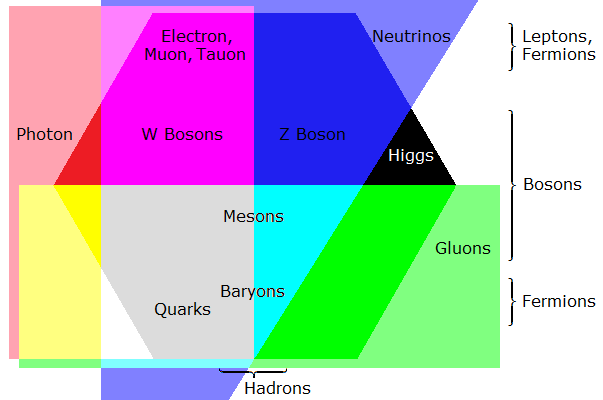
Well I got bored and altered my graph to show that mesons and baryons can be either electrically charged or neutral (see below). I had to alter the triangle (weak force) a bit to show this... but now the triangle is cut-off at the bottom. *Sigh* Perfection sure is elusive!
© H2Obsession, 2016